How to Identify an Emergency
The most important step in saving a life is recognising when something is seriously wrong. If a person suddenly collapses, is not breathing normally, or is unresponsive, quickly check whether they respond by calling their name and tapping their shoulder.
Look for chest movement and feel for a pulse. Watch for signs like gasping, no breathing, or a bluish face.
If there is no pulse, no response, or irregular breathing, call for help immediately and start CPR.
Calling for Help
Once you recognise an emergency, the next step is to get help as quickly as possible.
First, shout and get the attention of people nearby. Then call the local emergency number immediately, such as 108 for ambulance services.
- Check with the person who answers that you have reached 108.
- Describe the person’s condition: say whether they are male or female, unconscious, and not breathing.
- Let them know you are a first responder helping the person.
- Give your full address, with directions to the location and any nearby landmarks, and ask if an AED (Automated External Defibrillator) can be sent.
- After sharing all the details, ask them to repeat the details back. Make sure they have noted everything correctly.
- Give your phone to someone nearby and ask them to record a video as evidence.
- When the ambulance arrives, help get the person inside safely.
- Show your ID card to the medical team.
- Ask which hospital the patient will be taken to, take the driver’s phone number, and keep this information for your records.
Start CPR
When someone’s heart stops beating or they stop breathing, Cardiopulmonary Resuscitation (CPR) can help keep blood and oxygen moving through the body and to the brain until medical help arrives.
Compressions
First, clear the area around the patient and make sure you are on a dry surface.
Kneel at the side of the patient, with their arms by the sides of their body.
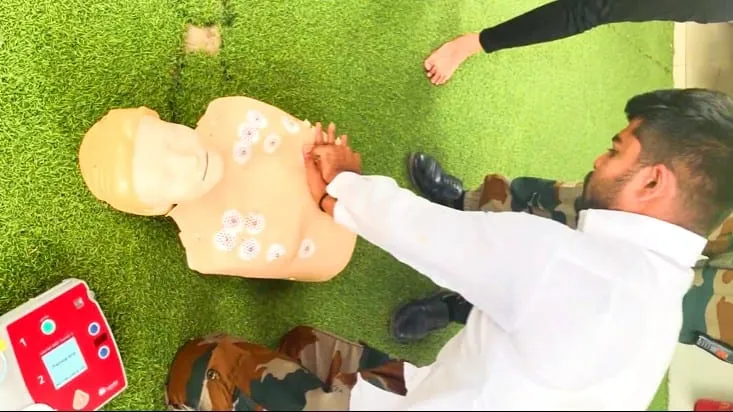
Place the heel of one hand on the centre of the chest (below where the ribcage meets) and put your other hand on top with the fingers locked.
Keep your arms straight with elbows locked, and make sure your shoulders are directly above your wrists.
Push hard and fast: compress the chest at least 2 to 2.5 inches (5 to 6 cm) deep, at a rate of 100 to 120 compressions per minute. The pressure comes from the hips, not the shoulders or elbows.
After one minute, check for normal breathing and a pulse. If you find neither, keep giving CPR until help arrives or an AED is ready.
If you get tired, switch with another person.
CPR for Children and Infants
CPR for children requires gentler handling. Use one hand for compressions on children, and two fingers for infants. Keep the compression rate at 100 to 120 per minute, but use less force.
CPR is one link in the Chain of Survival, the sequence of steps in an emergency response:
- Activation of emergency response (calling for help)
- High-quality CPR
- Defibrillation
- Advanced resuscitation by the ambulance team
- Post-cardiac arrest care in hospital
- Recovery
Using an AED
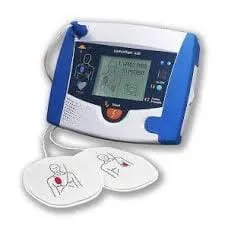
An Automated External Defibrillator, or AED, is a machine that helps restart a person’s heart during an emergency.
If the person is unresponsive and not breathing normally, use an AED as soon as one is available. Keep doing CPR while someone fetches it and attaches the pads, and only stop when the AED tells you to.
First, make sure the person is lying on something dry and that you are not in contact with wet surfaces or the patient, so that you do not get the shock yourself.
Then turn on the AED and listen carefully as it checks the person’s heart. If the AED says to give a shock, make sure no one is touching the person before pressing the button. The AED guides you with voice instructions to keep the person safe.
Points to Remember
- Stay calm and act quickly.
- It’s better to try CPR than to do nothing.
- Use a mask or something similar to protect yourself if giving breaths.
- Keep checking whether the person wakes up or starts breathing.
- Don’t stop CPR until help arrives or the person breathes again.
- Calling for help fast and using an AED can save lives.
When NOT to Perform CPR
There are times when you should NOT perform CPR. Knowing them keeps you and the person safe, and helps you act correctly in an emergency.
- Do not perform CPR if the person is breathing normally.
- Do not start if they are awake or have a strong pulse.
- Do not perform CPR if there are clear signs of death.
- Do not do CPR if there is a visible Do Not Resuscitate (DNR) order.
- Do not try CPR if the scene is unsafe, such as near fire, gas leaks, or electricity.
Learn CPR in Bengaluru: Workshops and Karnataka Civil Defence
You can join Basic Life Support (BLS) and CPR workshops conducted by Karnataka Civil Defence. These sessions are hands-on, often free or low-cost, and open to everyone.
You’ll learn how to perform chest compressions, use an Automated External Defibrillator (AED), and understand how CPR differs for adults and children. Workshops include practice on mannequins and step-by-step guidance from certified instructors.
Join Karnataka Civil Defence
Karnataka Civil Defence trains volunteers to respond to emergencies such as cardiac arrests, fires, and natural disasters. Anyone aged 18 and above can register through the official website or by visiting a local unit. Volunteers come from all backgrounds, including students, working professionals, and homemakers. It is a meaningful way to help your community while gaining lifesaving skills, and one of many ways of volunteering in Bengaluru.
For more details and to register, visit the Karnataka Civil Defence official site.
Special thanks to Shri Nirmal Jain, Area Warden, Civil Defence Rajajinagar, for this information, the workshop and his knowledge.
Civil Defence Rajajinagar conducts regular volunteering activities and life support training. Contact: 9886579977.
To find upcoming CPR workshops and other volunteering activities, check Sceen and its list of upcoming activities. For more causes that need hands right now, see places for volunteering in Bangalore that need help.